
Just when the fireworks industry thought it had weathered enough cost fluctuations, another $4,500 per container has come into play.
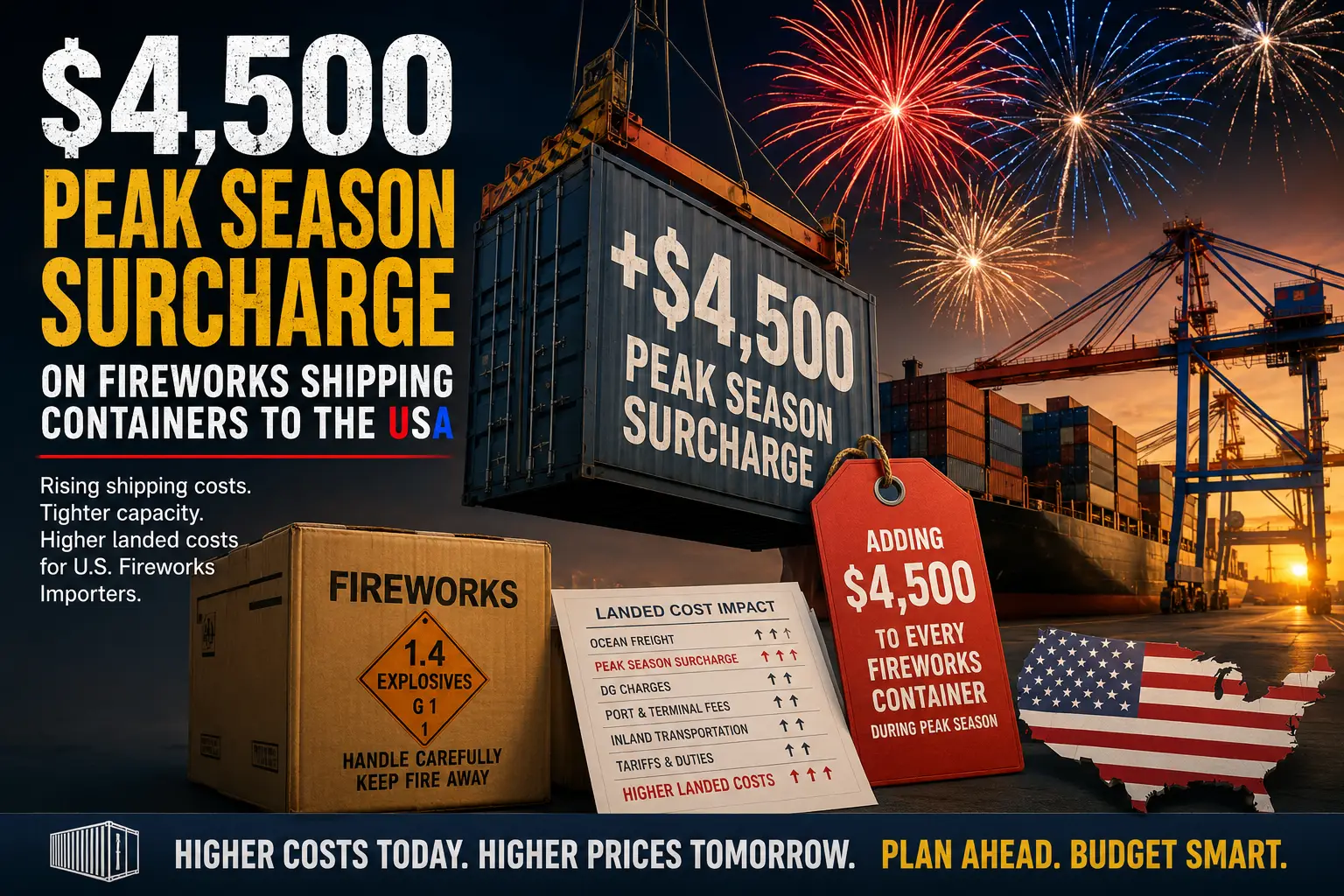
U.S. fireworks importers are now grappling with a new $4,500 Peak Season Surcharge (PSS) on shipping containers from China to the United States, adding yet another hefty expense to an already complex and pricey supply chain.
For businesses currently placing and budgeting their container orders for the upcoming fireworks season, that $4,500 is no small change.
It’s real money—and ultimately, someone has to foot the bill.
What Is the $4,500 Fireworks Peak Season Surcharge?
A Peak Season Surcharge, often called a PSS, is an extra freight charge that typically kicks in when shipping demand spikes and capacity becomes tight during busy times.
While this concept isn’t new, the scale of the current increase certainly warrants the fireworks industry’s attention.
An extra $4,500 per container can dramatically shift the landed cost calculations that importers relied on when they first negotiated prices, set up price lists, and started taking orders from their customers.
Plus, fireworks importers don’t enjoy the same shipping flexibility as those bringing in shoes, furniture, or consumer electronics.
Fireworks are classified as regulated dangerous goods. The options for transportation, approved routes, warehouses, vessels, and service providers are far more limited compared to regular consumer products.
This makes the fireworks supply chain especially susceptible to rising transportation costs.
What Does $4,500 Per Container Actually Cost?
The instinctive response might be:
“It’s just another $4,500 spread across an entire container.”
But let’s take a moment to put that figure into perspective.
Assuming a typical fireworks container holds around 68 CBM of merchandise, a $4,500 surcharge translates to approximately:
$66.18 in additional freight per cubic meter.
A carton measuring 0.032 CBM picks up approximately another:
$2.12 per carton.
A carton measuring 0.045 CBM picks up approximately:
$2.98 per carton.
Those numbers may not sound catastrophic individually, but multiply them across thousands of cartons and dozens—or hundreds—of containers.
Then remember that freight becomes part of the product’s landed cost.
Margins are calculated from there.
Wholesale pricing is calculated from there.
Retail pricing is calculated from there.
Eventually, that $4,500 works its way through the entire U.S. fireworks supply chain.
Fireworks Importers Are Already Facing Higher Costs
The timing isn’t particularly welcome.
The fireworks industry has spent the last several years dealing with an unusually volatile combination of ocean freight rates, tariffs, factory shutdowns, production limitations, regulatory expenses and supply-chain disruptions.
Now another freight surcharge gets added to the equation.
And this isn’t occurring in isolation.
The broader trans-Pacific shipping market is currently experiencing peak-season pricing pressure as well. Major ocean carriers have announced significant Peak Season Surcharges on China-to-USA freight during the 2026 shipping season.
That tells us the pressure isn’t limited exclusively to fireworks.
But the fireworks industry feels these increases differently because of the specialized nature of transporting Class 1 dangerous goods.
Why Fireworks Shipping Is Different
You can’t simply shop a fireworks container around to dozens of ordinary freight companies looking for the cheapest ocean rate.
The transportation of fireworks requires specialized handling throughout the supply chain.
That includes movement from fireworks-producing regions in China, approved storage and consolidation facilities, dangerous-goods transportation, port access, ocean transportation and specialized handling once the container reaches the United States.
Historically, a substantial portion of Chinese fireworks exported to the United States has moved through a relatively concentrated logistics network.
Limited competition means limited alternatives.
And when there are limited alternatives, importers have less leverage when additional fees are introduced.
Is $4,500 Really a “Peak Season” Surcharge?
That’s a question the industry should be asking.
Peak Season Surcharges are nothing new in international shipping.
The bigger question is:
When does peak season end?
If an additional $4,500 is truly a temporary surcharge caused by short-term shipping demand, importers should eventually expect it to disappear when that demand subsides.
But fireworks purchasing and shipping cycles are unusual.
American importers place orders months in advance. Chinese factories manufacture around production restrictions and shutdown periods. Containers then need to move during a relatively narrow window to reach American warehouses before the critical Fourth of July selling season.
That can create intense demand for a limited amount of fireworks shipping capacity.
For importers preparing their 2027 fireworks orders, the safest financial approach may be to assume the surcharge remains until there is confirmation otherwise.
If it disappears, great.
But building a landed-cost model around the assumption that it will disappear could be an expensive gamble.
The Bigger Question: What Is the Real Cost of a Fireworks Container?
For years, importers could focus heavily on FOB product cost.
Today, FOB price tells only part of the story.
The number that matters is landed cost.
Consider everything that can sit between the factory price and the merchandise arriving at an American warehouse:
Ocean freight.
Dangerous-goods charges.
Peak Season Surcharges.
Port and terminal charges.
Inland transportation.
Customs expenses.
Tariffs and duties.
Brokerage.
Warehousing.
Financing costs.
And now another $4,500 Peak Season Surcharge.
A product that looks inexpensive on an FOB price list can suddenly look very different after all those expenses are included.
Who Ultimately Pays the $4,500?
There are really only a few possibilities.
The importer absorbs it and accepts a lower margin.
The wholesaler passes it along to the retailer.
The retailer passes it along to the consumer.
Or everyone absorbs a portion of it.
In reality, the answer will probably be some combination of all four.
But one economic reality doesn’t change:
The $4,500 doesn’t simply disappear.
Someone eventually pays it.
Could Higher Freight Costs Change How Fireworks Are Developed?
There may also be a longer-term consequence that receives less attention.
Higher freight costs make cube efficiency increasingly important.
When every cubic meter of container space becomes more expensive, packaging and carton dimensions matter.
Products that deliver strong performance while occupying less container space become more economically attractive.
Importers may increasingly evaluate products not simply by:
“What does this item cost FOB?”
but instead:
“How much profit can this product generate per cubic meter of container space?”
That’s a very different way of evaluating a fireworks product.
And if elevated freight costs become permanent, it could influence future product development, packaging and purchasing decisions throughout the industry.
The Fireworks Industry Should Watch This Closely
The immediate issue is the additional $4,500 per fireworks container.
The larger issue is whether it is temporary.
If this truly is a Peak Season Surcharge and transportation demand eventually normalizes, importers should expect the charge to be reduced or removed.
If it remains indefinitely, however, the industry may eventually have to stop thinking of it as a surcharge.
It simply becomes the new cost of shipping fireworks.
For U.S. fireworks importers, wholesalers and retailers preparing for the next season, that distinction could be worth thousands—or hundreds of thousands—of dollars.
For now, importers would be wise to calculate the additional $4,500 into their landed costs and treat any future reduction as upside rather than budgeting today on the hope that the surcharge disappears tomorrow.